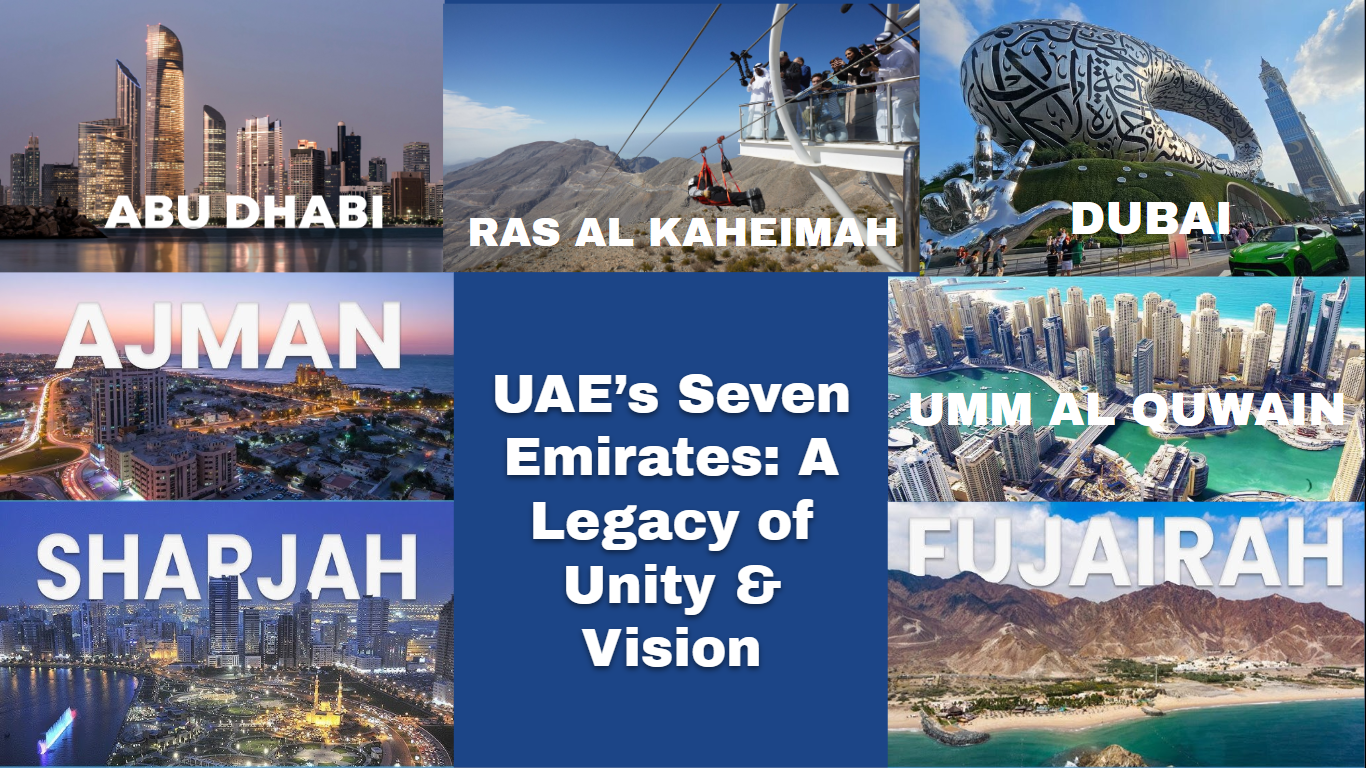
What are the seven Emirates of UAE? YES! This is the most basic query and misconception one should know, specially when understanding the country where Dubai is located. Dubai is not a country!!…. Yes you read it right Dubai is one of the Emirate (state or province) of UAE. So now here we clear our understanding that Dubai is not a country it’s a part of the UAE.
The United Arab Emirates (UAE) is a fascinating nation located in the Middle East. Formed in 1971, the UAE comprises seven emirates, each with its own culture and history. Their story of unity is both fascinating and inspiring. In this blog post, we will explore the fascinating history of the UAE and the seven provinces that make up this incredible nation.
When seven independent city-states from the Arabian Peninsula decided to unite under a federal government. The first rulers of the UAE were the Al-Nahyan and Al-Maktoum royal families, who signed the Declaration of Union on 2 December 1971.
The Formation Of UAE
After Britain left the region in 1968, the rulers of Abu Dhabi, Dubai, Sharjah, Ajman, Umm Al Quwain, Ras Al Khaimah, and Fujairah united to form the UAE, ending the era of the Trucial States.
The United Arab Emirates (UAE) borders Oman and Saudi Arabia in the southeast of the Arabian Peninsula. Abu Dhabi, Dubai, Sharjah, Ajman, Umm Al-Quwain, and Fujairah are the six emirates that make up the United Arab Emirates (UAE). In December 1971, the seventh emirate, Ras Al Khaimah, joined the federation. Abu Dhabi is the capital of the seven emirates, which is also the largest and wealthiest.
The United Arab Emirates, once a vast desert, is now a country where you can find a perfect balance of modernity and tradition. The seven UAE emirates now offer an exciting mix of adventure, history, culture, and fun for everyone, starting with their humble beginnings in camel breeding, pearl farming, and fishing.
Federal Structure Of UAE
The United Arab Emirates (UAE) has grown rapidly since its founding in 1971 and is now well-known for its modern infrastructure, international events, and position as a transportation and trade hub. UAE celebrated its 50th anniversary of federation in 2021.
The newly formed UAE secured recognition from the US and UK in 1972. The Constitution distributes power between the federal government and the seven emirates, with each emirate ruled by a hereditary leader and the president and prime minister elected by their councils.
A Supreme Council made up of the rulers of each Emirate, a Council of Ministers, and a Federal National Council make up the UAE’s federal structure. Each Emirate has its own Ruler, local governments, courts, and police departments. Despite being a nation-state, the United Arab Emirates’ seven emirates are governed by distinct royal families.
His Highness (HH) Sheikh Mohammed bin Zayed Al Nahyan is the President of the United Arab Emirates. Vice-President, Prime Minister, and Minister of Defense is HH Sheikh Mohammed bin Rashid Al Maktoum, the ruler of Dubai.
Since its formation, the UAE has experienced rapid economic growth due to its strategic location at the intersection of Europe, Africa and Asia. It is now home to some of the world’s most impressive architecture and modern developments. The country also continues to invest heavily in areas such as education, healthcare and infrastructure, making it one of the most prosperous nations in the Middle East.
The Seven Emirates of UAE
Let’s take a closer look at each of the seven emirates that make up the United Arab Emirates and see how special they are.
1. Abu Dhabi
Abu Dhabi is the capital of the United Arab Emirates, and one of its seven Emirates. Located on a T-shaped island jutting into the Persian Gulf, it is the largest of the UAE’s seven provinces. With its rich oil reserves, Abu Dhabi is the wealthiest of the Emirates, and has the largest population.
The capital Emirate Abu Dhabi is a city of contrasts, with modern skyscrapers towering over traditional Islamic architecture. It is also home to some of the world’s most luxurious hotels and shopping malls.
In addition to its modern development, Abu Dhabi is steeped in history and culture. Ancient mosques and forts stand as reminders of a bygone era, while museums and art galleries showcase the work of modern Emirati artists.
Stunning Islamic architecture is the Sheikh Zayed Grand Mosque. The Sheikh Zayed Mosque, which is considered to be one of the largest mosques in the world, combines grandeur and magnificence with the values of Islamic traditions and the rich history of the United Arab Emirates. It doesn’t matter what time of day you go, this beautiful mosque is a sight to behold.
The city’s pristine beaches and desert parks are perfect for those looking for an escape from the hustle and bustle of urban life. Visitors can take a desert safari to explore the vast expanse of dunes, or even get close to wild animals at nearby wildlife parks.
This is the place to be if you enjoy the rush of fast travel. For guests of all ages, Ferrari World Abu Dhabi has thrilling rides and experiences. Walking on the destination’s famous red roof and riding a zipline across it are two of the incredible attractions on this world-class theme park’s extensive list of offerings!
For travelers who prefer an active holiday, Abu Dhabi offers plenty of outdoor activities, including kayaking, windsurfing, camel rides, and deep sea fishing. Food lovers will be pleased to find a range of international cuisines in the city’s many restaurants.
Overall, Abu Dhabi is an exciting destination for travelers looking for a mix of ancient and modern attractions, activities, and experiences.
2. Dubai
UAE’s Dubai Emirate is the second largest. However, Dubai has the largest population, most of whom are expats from all over the world due to the city’s thriving tourism and business sectors.
UAE’s Dubai Emirate is the most populous of the seven Emirates in UAE and has the second-largest economy, after Abu Dhabi. Its population stands at nearly 2.7 million people, with more than 90% of its citizens being foreign expatriates. As the UAE’s multicultural hotspot, Dubai hosts expats from over 200 nationalities. Its strategic location and thriving business scene have earned it the title “Gateway to the Middle East.”
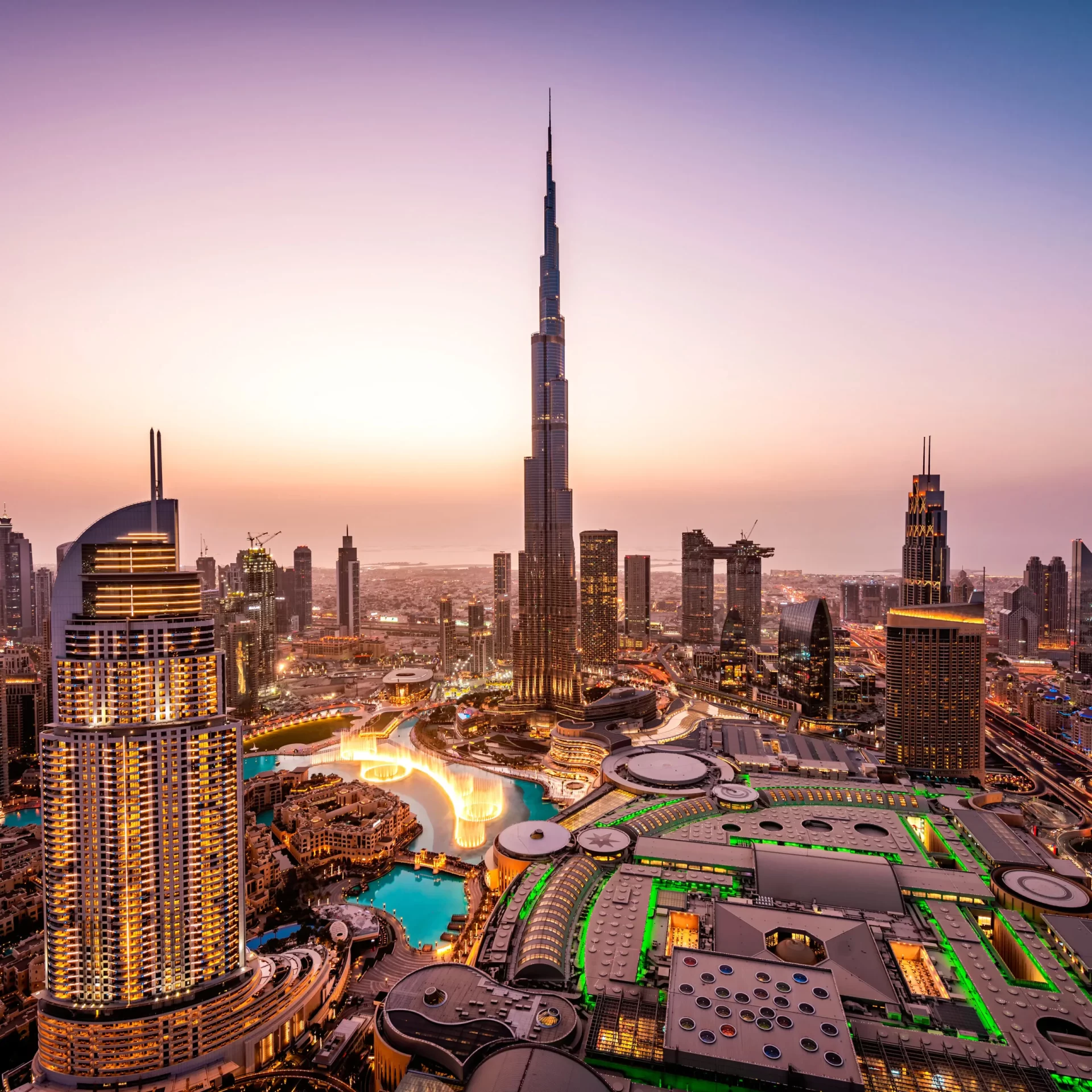
Dubai is one of the seven provinces that make up the United Arab Emirates (UAE). It is located on the southern coast of the Persian Gulf, on the Arabian Peninsula. Dubai is known for its cosmopolitan atmosphere and stunning skyline. As we discussed earlier, Dubai is also a major business hub, and is home to many of the world’s leading corporations.
One of Dubai’s main attractions is its shopping malls and markets, which are considered to be some of the best in the world. The city is also renowned for its numerous cultural events and festivals, and for its nightlife and entertainment options. There is something for everyone in Dubai, from family-friendly activities to extreme sports and adventure.
The city’s infrastructure is well-developed and constantly evolving, with an impressive airport and sophisticated public transportation systems. Dubai also has an efficient road network connecting it to other cities in UAE and beyond.
There is no need to introduce Burj Khalifa. It is anticipated that it will continue to be the tallest building in the world for some time to come. The Burj Khalifa has a lot to offer visitors. You can have it all, whether you want afternoon tea or a view of Dubai from the Burj’s top.
Dubai Eye is the translation of the name to the world’s largest observation wheel, Ain Dubai, is an impressive addition to Dubai’s extensive list of desirable destinations. A ride on this ultra giant observation wheel is a one-of-a-kind experience that takes about 48 minutes. So, when you ride this Dubai observation wheel, you get to see the Burj Khalifa, Palm Jumeirah, and Burj Al Arab like you’ve never seen them before.
The Museum of Future promises an exhilarating experience for all lucky visitors. Here, you can learn about the future of Dubai and other cutting-edge technologies. His Highness Sheikh Mohammed bin Rashid Al Maktoum promises this future museum to be the most beautiful building on Earth.
This is the biggest counterfeit island on the planet, molded like a palm tree – complete with the fronds and a trunk. Palm Jumeirah is an extravagance improvement that offers very good quality waterfront living for inhabitants, with all way of life conveniences and relaxation exercises close nearby.
Dubai is one of the premier destinations in the Middle East for both business travelers and tourists alike. With its modern infrastructure, vibrant culture, and endless entertainment options, there is no better place to explore the wonders of the UAE than in Dubai.
The emirate’s real estate and tourism industries make up the majority of the economy. But this wasn’t always the case. One of Dubai’s fascinating facts is that its economy was heavily dependent on fishing and pearl farming up until the 1700s. In a similar vein, the architectural history of Dubai is also quite exciting.
Dubai is a popular tourist destination for many reasons.
3. Sharjah
Sharjah is one of the seven emirates that make up the United Arab Emirates (UAE). Located in the northeastern part of the country, it is the third largest emirate and has a population of 1.4 million.
The Sharjah Emirate is known for its cultural, commercial and educational heritage. As such, it was named the “Cultural Capital of the Arab World” by UNESCO in 1998. The port city of Khor Fakkan is located within the emirate, making it a major trading hub for the region.
The capital city of Sharjah is also home to the University of Sharjah and a number of other higher educational institutions, making it a great destination for students from all over the world.
The emirate is well-connected to other parts of the UAE and the Middle East via its airports, roads and ports.
In recent years, Sharjah has seen a number of large-scale projects undertaken by the government, including the development of Al Majaz Waterfront and the Eye of the Emirates Ferris wheel. It also has a vibrant art scene with numerous galleries and museums showcasing local and international artists.
Sharjah’s strong cultural identity is evident in its numerous festivals and events that take place throughout the year. From sporting events to musical concerts, art shows to historical reenactments, there’s something for everyone in this vibrant city.
Sharjah Safari Park consolidates 12 themed regions in Africa. The breathtaking Safari park covers an area of 8 square kilometers and is home to 120 types of creatures, 1 lakh African trees, including an umbrella-molded Acacia Tortillas. On the main days, guests can see in excess of 1000 creatures and birds, of which around 70 species are tracked down in Africa. The greatest benefit of this park is that travelers can see various types of creatures up close.
You can also stop for a picnic with your family along Khalid Lagoon, an artificial lagoon with 1,720,000 square hectares of water surface. You can also take abra boat excursions and enjoy music and light shows at the Sharjah Fountain.
Overall, Sharjah is a unique and vibrant emirate with an exciting blend of traditional values and modern amenities. Whether you’re visiting for business or pleasure, you’ll find plenty to do in this culturally rich emirate.
Cost of living in Sharjah (United Arab Emirates) is 25% cheaper than in Dubai (United Arab Emirates).
4. Ajman
Ajman is one of the seven emirates that make up the United Arab Emirates. It is the fifth largest emirate in the UAE. It is located on the Persian Gulf coast of the UAE, north of Sharjah and southeast of Umm Al Quwain. With an area of only 260 square kilometers, it is the smallest of all seven emirates. The capital city is Ajman and other major cities include Manama and Masfut.
Ajman has a long history dating back to the mid-19th century when the Bani Yas tribe moved from Abu Dhabi to settle in the area. Several dynasties ruled Ajman until the British Empire took control in 1820.
Today, Ajman remains one of the most traditional emirates. It’s famous for its bustling gold souk, markets and beaches. It also boasts some of the best museums in the region such as the Ajman Museum and Al Hisn Fort. Tourism is growing rapidly here, as Ajman’s attractions draw visitors from around the world.
5. Umm Al Quwain
Umm Al Quwain is one of the seven emirates that make up the United Arab Emirates (UAE). It has an area of 800 square kilometers, making it the smallest emirate in the country. Umm Al Quwain is located on the west coast of the UAE, between the other two emirates, Ajman and Ras Al Khaimah.
Umm Al Quwain is home to many different cultures, religions, and nationalities. While Arabic is the primary language, English and Hindi are commonly used. The population is mostly Sunni Muslim, alongside a notable Hindu community.
The economy of Umm Al Quwain is based primarily on fishing and tourism, which makes up a large part of the Emirates GDP. There are many tourist attractions here, including the Umm Al Quwain Museum, which showcases artifacts from the ancient history of this area. The desert landscape of Umm Al Quwain is also popular with tourists, and there are many resorts and hotels located here.
Umm Al Quwain has a long and proud history that dates back centuries. The first settlers in this region were the Bani Yas tribe, who settled here in the 17th century. The Al Bu Falasah dynasty later ruled the region, which joined the United Arab Emirates in 1971.
Today, Umm Al Quwain remains a vibrant and culturally diverse emirate that continues to attract visitors from around the world.
6. Ras Al Khaimah
Ras Al Khaimah is one of the seven provinces that make up the United Arab Emirates (UAE). Located on the north coast of the Arabian Gulf, it is one of the most geographically diverse regions in the UAE.
Often called “the land of sun, sand, and sea,” Ras Al Khaimah showcases a vibrant cultural heritage. The province has a number of archaeological sites, including the ruins of Julfar, once a powerful trading port on the Indian Ocean, and a number of forts and castles.
Ras Al Khaimah, known for its natural beauty, aims to become a leading hub for meetings, incentives, conferences, and events. To help find a balance, the emirate is taking a measured approach with a controlled pipeline of sustainable development.
The economy of Ras Al Khaimah is based on oil production, manufacturing, tourism, and real estate development. The region is home to some of the most beautiful beaches in the UAE, including Khatt Springs Beach, Al Rams Beach and Saraya Island,Al Hamra Beach and a number of other popular spots.
From the National Museum and Sheikh Zayed Mosque to golf courses and water sports, Ras Al Khaimah caters to every traveler. Don’t miss its malls and traditional souks for local treasures.
UAE’s adventure zone is Ras al Khaimah, an emirate with places like Jabal Jais that have rugged mountains. Jebel Jais, the ultimate adventure destination, is more than just a towering 2,000-meter mountain. Ice skating, zip lining, and camping are just a few of the many activities available to visitors here.
Wadi Shawka in the Hajar Mountains draws adventure seekers with its natural pools, Shawka Dam views, and nearby heritage sites. Its scenic trails make it one of the UAE’s most accessible hiking spots and a top tourist destination. Ras Al Khaimah offers a unique blend of culture and natural beauty, making it a must-visit emirate.
7. Fujairah
Fujairah is the fourth largest emirate in the United Arab Emirates, located on the east coast of the country. The region borders the Gulf of Oman to the east, Ras Al Khaimah to the north, Sharjah and Ajman to the west, and Oman to the south.
Fujairah, called the “land of wild waters and wadis,” is the UAE’s most tranquil and mountainous emirate.
Fujairah holds northern Dibba, and the rest extends into Sharjah and Oman. Paved roads now connect the capital, Sharjah, and the Gulf of Oman coastline across the peninsula.
The city of Fujairah is a vibrant port city, with an international airport and a population of over 150,000 people. The main economic activity in Fujairah is tourism, as well as agriculture and fishing. Designated as a “Free Zone,” the city lets companies operate more smoothly than in other parts of the UAE.
Fujairah’s cultural heritage dates back thousands of years, with many archaeological sites scattered throughout the emirate. These include graves from the Bronze Age, remains from the Iron Age, and buildings from the Islamic period.
The rugged mountains, valleys, and low plains make Fujairah’s landscape unlike anywhere else in the UAE. The area has seen new residential developments, yet it still offers plenty of natural sights.
Fujairah is known for its beaches, which offer peace and tranquility. The region offers many beautiful spots for scuba diving and snorkeling.
The only reef break in the country is at Tim’s Reef in Fujairah. The reef has excellent waves for surfers and faces the Indian Ocean. This is the place to be if you want to catch some wild waves.
Another nature spot in Fujairah has public pools filled with water from the nearby Ain Al Madhab Hot Springs. You can enjoy barbecue, badminton, swimming, and many other activities at Madhab Spring Park.
Fujairah’s Wadi Wurayah, between Bidiyah, Khorfakkan, and Masafi, supports rich wildlife and holds the distinction of being the UAE’s first protected mountainous park.
Fujairah is a great place to visit, whether you’re looking for a relaxing beach holiday or an exciting adventure. From water sports to museums, there’s plenty to explore in this charming emirate.
Final Words
The United Arab Emirates is an incredible country with a rich history and culture. Since 1971, the UAE has become one of the Middle East’s most progressive countries. Thanks to the collaboration of the seven provinces, it has flourished economically and culturally. Today, the country shines as a prominent regional leader. The UAE’s emirates are unique, yet the nation remains united and lively. Its people’s resilience makes exploring it unforgettable.
This wraps up our journey through the 7 Emirates of the UAE. From luxury and thrills to peaceful retreats, the country has something for everyone. The UAE offers countless must-visit vacation spots and stunning natural attractions waiting to be explored. Many individuals of Asian, European, American, and African nationalities live as one in the Unified Bedouin Emirates. Visiting the UAE is a great choice, with travel packages available for every budget.The distance between every emirate is a couple of hours. To make the most of your visit, include several emirates in your UAE itinerary.