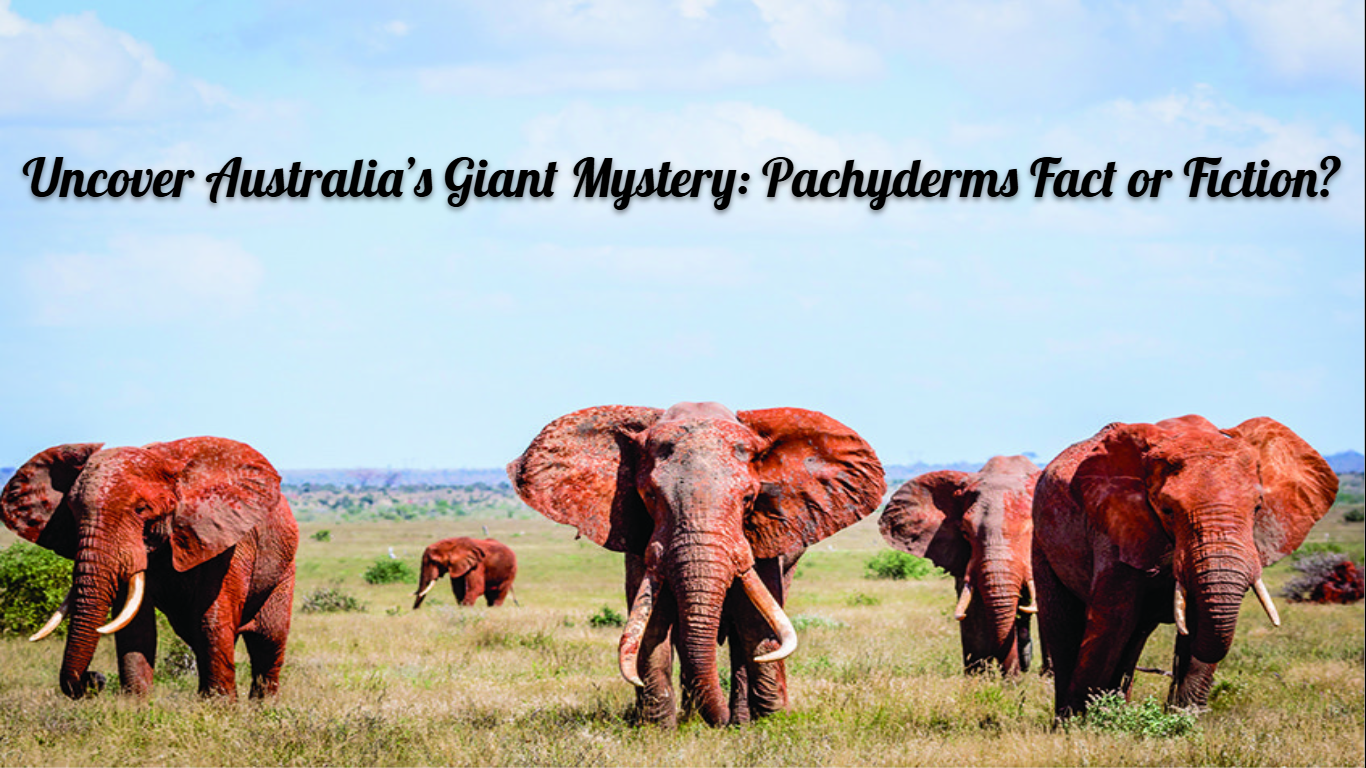
Is there an elusive population of wild elephants living in the Australian outback? While this may sound like a strange question, it is one that has been asked for centuries. The debate over Australia’s mysterious pachyderms has captivated generations of people, with some claiming to have seen these remarkable creatures in the wild.
In this blog post, we will explore the possibility of wild elephants living in Australia and consider the evidence for and against their existence. We will also take a look at some of the theories surrounding the mystery of these elusive creatures.
The Fascinating History of Pachyderms in Australia
Despite the popular belief that elephants are native to Africa and Asia, they have actually lived on nearly every continent at some point in history. Australia is no exception. Fossil records show that prehistoric elephants, including stegodons and mammoths, roamed the Australian continent during the Pleistocene epoch.
However, it’s important to note that these ancient pachyderms were not the same as the elephants we know today. They were often much larger and had unique adaptations to their environment, such as elongated tusks and flat, crushing molars.
Although prehistoric elephants disappeared from Australia thousands of years ago, humans have introduced some species in modern times. You can see these elephants in zoos, wildlife parks, and circuses across Australia, but they do not live in the wild.
So, while there may not currently be wild elephants roaming the outback of Australia, the country does have a fascinating history with these majestic creatures.
Claims of Pachyderms Sightings in Australia
Over the years, there have been numerous claims of elephant sightings in various parts of Australia. Some reports have suggested that there may be small, isolated populations of elephants living in remote areas of the country.
One famous sighting occurred in 1910, when gold miners in Western Australia reported seeing a herd of elephants in the bush. The report gained wide attention, with many believing it proved a previously unknown population of pachyderms in Australia.
Since then, there have been occasional reports of elephant sightings in other parts of the country. Some believe these sightings come from escaped circus or zoo elephants, while others speculate about feral populations in the wild.
Despite these claims, there is no evidence of wild elephants in Australia. The government does not recognize any populations, and scientists have found no proof of sightings.
Unraveling the Pachyderms Myth Across Australia
Despite numerous claims of sightings and alleged photographs, there is no concrete proof that wild elephants roam Australia. The idea of pachyderms wandering freely has become an urban legend. In reality, most sightings are due to misidentification. Large mammals like feral pigs and water buffalo are often mistaken for elephants.
There is no evidence that elephants ever lived in Australia. Australia has been isolated for millions of years, with no records of native elephant species. The only evidence comes from bones and teeth in ancient Aboriginal settlements, likely traded from Asia centuries ago.
Other Large Mammals in Australia
Although elephants don’t roam wild in Australia, many other large and fascinating mammals can be found across the land.
One such example is the kangaroo, a unique marsupial known for its powerful legs and distinctive hopping gait. The red kangaroo, Australia’s largest species, can reach 6 feet tall and weigh over 200 pounds.
The saltwater crocodile, the world’s largest living reptile, can grow up to 23 feet long and weigh over a ton. These apex predators roam northern Australia, mainly in the Northern Territory and Queensland.
Australia is also home to several species of large bats, including the spectacled flying fox and the black flying fox. These creatures can have wingspans of up to 4 feet and play important roles in pollination and seed dispersal.
Although elephants don’t roam Australia, many other awe-inspiring mammals await discovery in this unique and diverse land.